Softness Remains: Chiu Chen-Hung solo exhibition
-
Overview

Dates
03.07-04.25.2026
Reception
03.14.2026 (SAT.) 4:30 p.m.
Venue
TKG+ B1, No. 15, Ln. 548, Ruiguang Rd., Neihu Dist., Taipei, Taiwan
This exhibition is generously supported by Tianmei Art Foundation.
“In an era of catastrophic transformation, how can art reconstruct subjectivity, consciousness, and ethics from fractured materials?” — Chiu Chen-Hung
As the new year begins, TKG+ presents Softness Remains, a new solo exhibition by artist Chiu Chen-Hung. For those born and raised on the island of Taiwan, poised along the Pacific Ring of Fire, natural disaster is not merely an image of devastation seen on the news. It is a visceral experience—the unease that seizes the body during a seismic jolt, the lingering anxiety etched into memory long after the ground has settled. The rupture brought by disaster leaves behind vivid marks in the palette of recollection, forming a deep-toned ground shared by all who live here. How to face, feel, and remember the everyday after such fracture is a collective condition among the island’s inhabitants.
-
Unlike works of disaster literature, such as Haruki Murakami’s After the Quake, which portrays how individuals respond to the indifference of the universe, Softness Remains turns its focus toward the act of remembering. It situates time within the weight and debris of what remains. Through the language of sculpture, Chiu attempts to recontain moments of disarray and breakage within a new order—one that does not resolve or erase, but gathers what has splintered into a fragile, emergent coherence.
In the evolution of contemporary art, sculpture has long since moved beyond the classical frameworks of monumentality and representation. No longer confined to serving as a symbolic vehicle for religious narratives or heroic historiography, sculpture, particularly since the twentieth century, has undergone a profound reorientation. As art deepened its reflection on form and systems of value, sculpture gradually shifted from transcendent ideals of the sublime toward an engagement with everyday politics and lived realities. It began to address concrete dimensions of experience—labor, gender, ethnicity, and memory—bringing into view the fragile textures of embodied life.
This transformation in value was accompanied by an expansion of material vocabulary. Industrial materials, ready-mades, and even the incorporation of sound and performative gesture unsettled sculpture’s historical dependence on precious materials and the authority and permanence they implied. Sculpture became an open and relational practice rather than a monument to endurance.
Within this trajectory, Chiu Chen-Hung consciously avoids shaping his work around direct references to specific events. Instead, he approaches sculpture as a medium through which time, space, and the body may be engaged. In doing so, he opens a field where abstract thought becomes perceptible, allowing contemporary sculpture to signify far beyond the limits of its physical form.
For Chiu, order—or the configuration that emerges through sculptural language—is not aligned with classical ideals of grandeur or immortality. It is a form of wholeness achieved through repair. By mending fractures and reassembling fragments, or by allowing rupture itself to acquire aesthetic renewal through artistic intervention, he redefines completion through imperfection. Whether attending to the outward life-forms of flora and fauna, or to the wounds and deficiencies embedded within organic matter, Chiu transforms these observations into the foundation of another kind of integrity. Like the Japanese craft tradition of kintsugi, in which the cracks of a broken vessel are incorporated into its design, his sustained care for fragments and absence remains central to his artistic ethos.
In his work Concrete Zoo, Chiu Chen-Hung reflects, “I see the emergence of these concrete animals as a kind of filler for a particular era. To me, they are like materials, or ready-mades, that lack confidence.” These animal sculptures, produced by anonymous craftsmen, are crude and comically awkward in form. They show none of the proportional precision expected from trained sculptors, nor are they rendered in materials such as marble, bronze, or stainless steel—those traditionally associated with perfection and permanence. And yet, it is precisely these unstable, deteriorating, and flawed sculptures that speak most vividly to the mission of sculpture itself. Nestled within the forested hills of Meilun, their wild vitality offers a poignant counterpoint to classical ideals. They mark the passage of time not through monumental permanence but through weathered fragility, bearing the weight and meaning of time in ways that only such imperfect objects can.
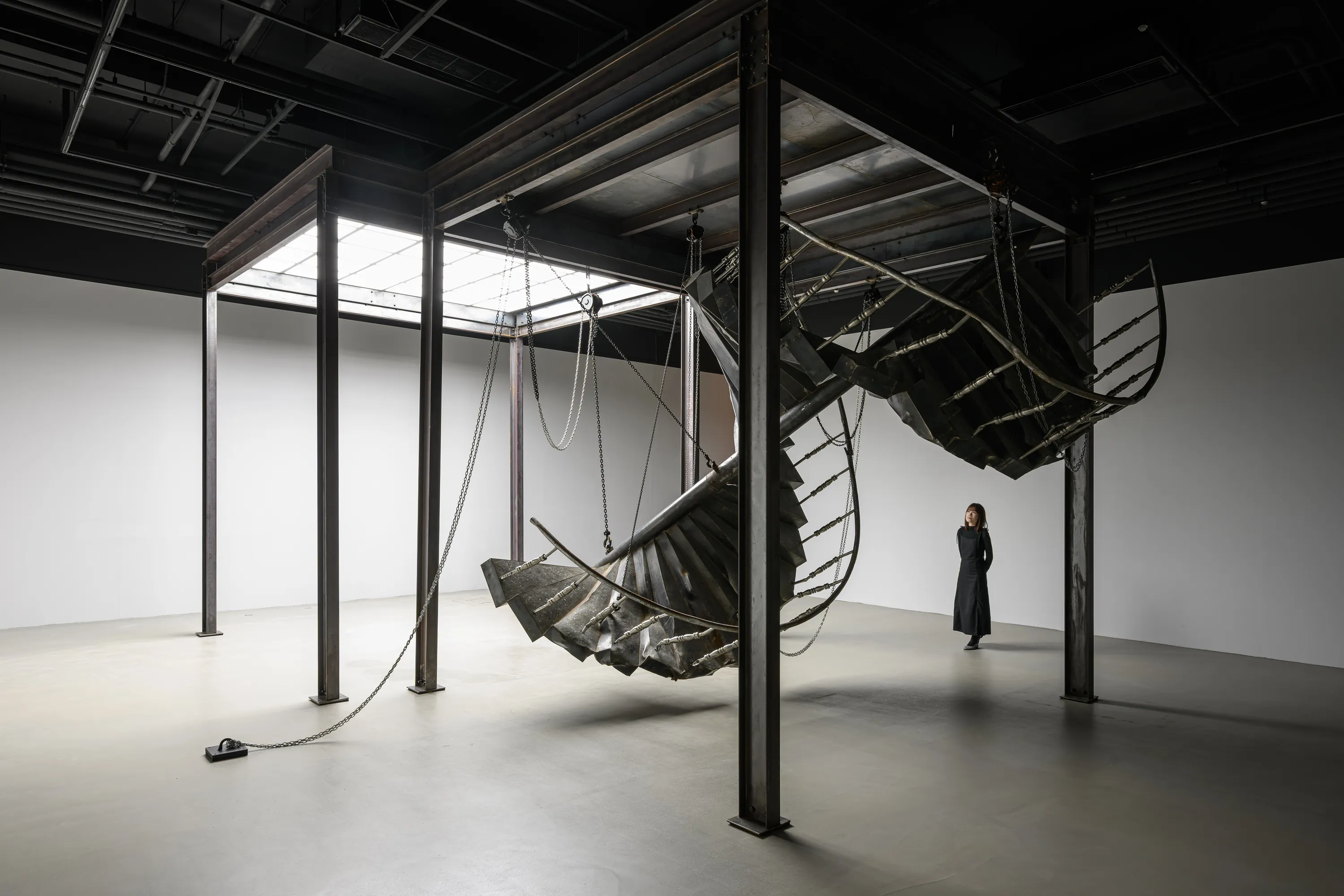
In Softness Remains, Chiu Chen-Hung works with salvaged materials—steel reinforcement bars, bricks, and concrete recovered from buildings that collapsed during earthquakes. From these fragments, he reconstructs sculptural forms: a spiraling staircase, cabinet structures, slope reinforcements, and biomorphic lighting fixtures. Together, they suggest a heterogeneous yet interdependent order drawn from the wreckage of reality.
In Unbalanced Spiral, the spiral form draws on the Fibonacci sequence and the double helix of DNA, primal geometries that signify the laws of life and self-replication. Yet here, the spiral is no longer stable or perpetually ascending. It veers off-center—ruptured, asymmetrical. Traces of fracture, displacement, and regeneration are inscribed along its path. Each stair tread functions like a mold, embedding fragments from various disaster zones. The terrazzo surfaces preserve sedimented layers of time and erosion, congealing into a spiral that appears structurally coherent yet inherently unbalanced.
-
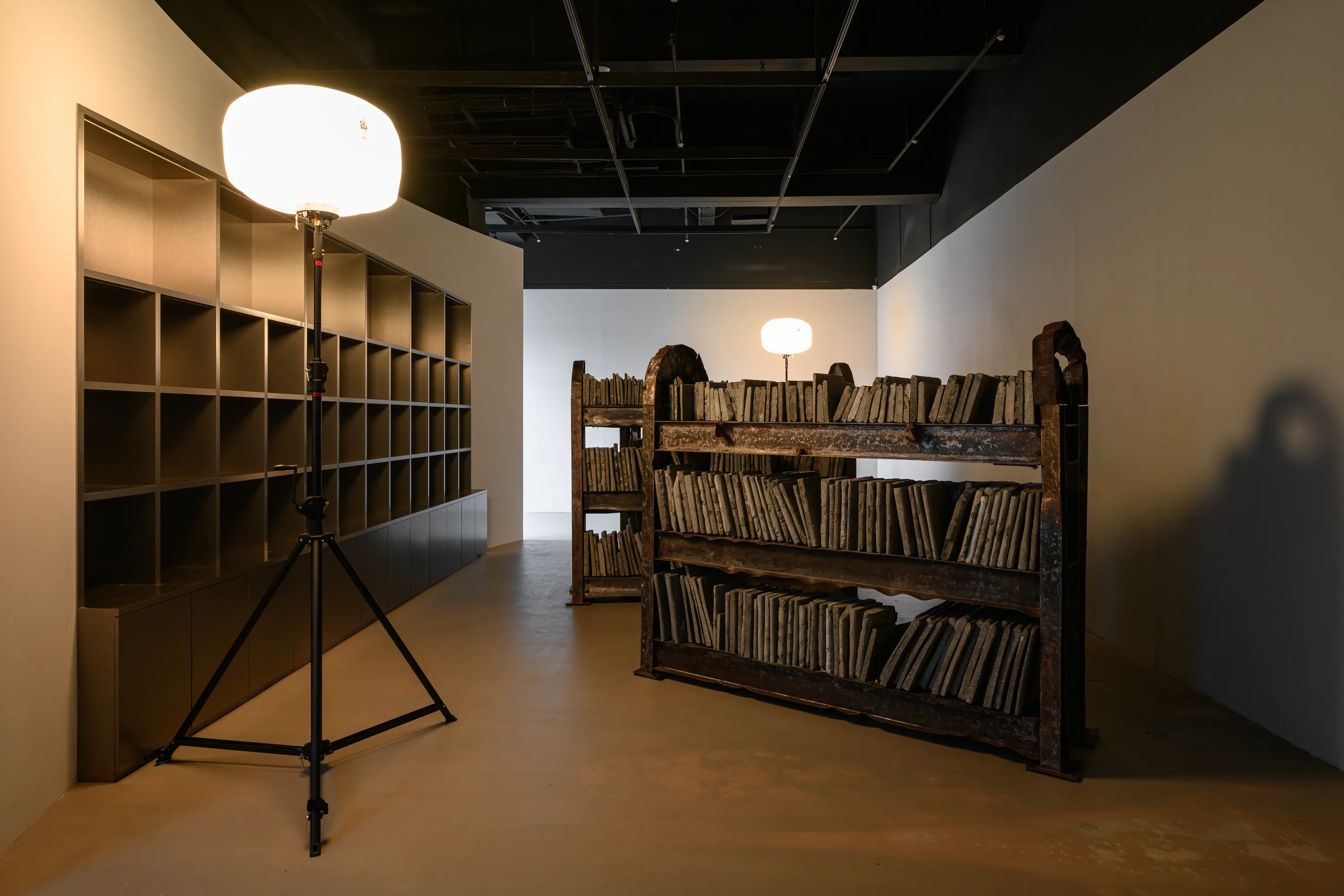
In Night and Soul, Chiu Chen-Hung transforms the twisted rebar and shattered concrete left in the aftermath of an earthquake into the sculptural structures of bookshelves and books, constructing a miniature library that carries memory. The faint glow cast by a work lamp moves slowly across metal and debris, suffusing the space with an almost damp atmosphere, as if a segment of time once buried beneath rubble were seeping back to the surface.
Chiu has remarked that this work intertwines recurring nightmare imagery experienced under prolonged psychological strain with the ruins left behind by the April 3 earthquake. Salvaging remnants from abandoned sites, he allows warped rebar to form the skeletal frame of the shelves, while fractured concrete—crushed, mixed with cement, and recast—takes the shape of books. In this reconfiguration, trauma and material converge, layered into a presence that resists articulation yet continues to gaze back at the viewer.
-
Featured Works
-
Within this trajectory, it becomes clear why Chiu Chen-Hung is drawn to dialogue with objects of all kinds: mineral remnants, metal tools, work permits, slope stabilization meshes. These fragments of architecture and instruments of labor, rarely seen as part of sculptural discourse, are absorbed into Chiu’s sculptural system. For the artist, these marginal, unassuming materials offer precisely the vocabulary needed to mend the fractures of time. They traverse the boundaries between nature and industry, organic and geometric, absence and wholeness.
Returning to the title Softness Remains, Chiu’s notion of softness is not merely an expression of human resilience. It speaks to the material’s own capacity to bear witness. It is about sculpture as a contemporary form of recordkeeping—capturing, through its oblique angles and fractured syntax, the tense and interdependent relationship between people, objects, and the natural world in our time.
-
Installation View
-
Artist
-
NTUH Health Building Public Art Project "Dialogues Reset|", photo by RoHsuan Chen.